I went for my two-hour election board training today, and it was an interesting experience. I was in a room with about 200 other "chiefs" and "assistant chiefs" for the upcoming midterm elections. I was one of maybe two volunteers who hadn't had duty before.
The atmosphere was electric: there had been problems recently in Montgomery County, MD, and Fairfax County doesn't want to repeat the performance. And there are the details (boy, are there details). I have a thick, 3-ring binder that I have to memorize before Tuesday so that I can make sure that those who show up to vote and are eligible can vote. This will be an arduous process. I have to be there at 5 a.m. and can't leave until the polls close. That's at least 14 hours of duty. But I think it's my responsibility as an American to take part in the political process, and there are many ways to do that: volunteer for a political party; do jury duty; report crimes; respond when someone's in need. All of these things we can do and should do.
Here's an interesting statistic that I learned about this contentious election coming up: because it's not a presidential election, generally the voter turnout is much less. During other midterm elections, about 11,000 absentee ballots are filled out. However, Fairfax County expects approximately 30,000 absentee ballots when all is said and done. That's the equivalent of a presidential election. Tuesday is going to be really busy--so get out early and vote!
For information on voting in Prince William County, clink on the PW hyperlink. For Stafford County, click on that one. See you at the polls!
Tuesday, October 31, 2006


Monday, October 30, 2006
Week 2 Post 1: Reading the Post
Of course I've been reading, and watching, and living the life of an election volunteer for Fairfax County for the upcoming November 7 elections. What does this mean, exactly? I don't know: I'll be in training at the Fairfax County Government Center on Halloween (fitting, isn't it?), and I'll post my second entry this week after that educational affair. Until then, I realize that, election official or no, I am not immune to the spate of negative election practices done throughout the country, but especially on our doorstep. We're in the middle of the muck during a very important race: that of the Virginia senatorial race between Jim Webb and incumbent George Allen.
Take a look at the examples. Even in our own local paper, the Washington Post highlights the logical fallacies (on a play on the fallacy Ad Hominem: an argument in which the person is attacked; it's like saying that President Bush is wrong on Iraq because he is a horrible public speaker). The argument might not be wrong, but the logic behind it is certainly flawed. Yet I digress. What I have seen from Allen is a TV ad attack on Jim Webb's fictional novels and statements (however archaic and sexist) that Webb made in 1979. Webb has countered with reminding viewers of the "macaca" racial slur that Allen used this year, and his obvious alignment with the "stay the course" phraseology this year when asked about Iraq policy.
But here's what I'd like to know: Where do they discuss and/or promote issues relevant to us? What do they stand for, not what do they think their opponent is wrong for? I've received two flyers in the mail this week from the Jim Webb campaign. He's all for having our tuition be tax-free, removing troops from Iraq, not privatizing healthcare. So that's something. I've had nothing in the mail from George Allen. Nor have I seen much positive stuff on TV from either. At least Webb did make it to NVCC Woodbridge last Wednesday, meeting with one of our history classes and discussing the issues.
I guess it comes down to either reading or watching. I do both. If I just watched TV, I'd be so filled with vitriolic smearing and bravado that I'd either have to have a testosterone shot or move to Bermuda. Either way, it feels much like a fiasco. I hope it doesn't get worse on election day. If you see a political ad that only highlights important issues, let me know.
Reference Cited
Booth, William. (2006). Ads Hominem: Nasty Campaign Bites. Washington Post, October 29: D1. Accessed October 29, from http://www.washingtonpost.com/wp-dyn/content/article/2006/10/28/AR2006102800967.html
Take a look at the examples. Even in our own local paper, the Washington Post highlights the logical fallacies (on a play on the fallacy Ad Hominem: an argument in which the person is attacked; it's like saying that President Bush is wrong on Iraq because he is a horrible public speaker). The argument might not be wrong, but the logic behind it is certainly flawed. Yet I digress. What I have seen from Allen is a TV ad attack on Jim Webb's fictional novels and statements (however archaic and sexist) that Webb made in 1979. Webb has countered with reminding viewers of the "macaca" racial slur that Allen used this year, and his obvious alignment with the "stay the course" phraseology this year when asked about Iraq policy.
But here's what I'd like to know: Where do they discuss and/or promote issues relevant to us? What do they stand for, not what do they think their opponent is wrong for? I've received two flyers in the mail this week from the Jim Webb campaign. He's all for having our tuition be tax-free, removing troops from Iraq, not privatizing healthcare. So that's something. I've had nothing in the mail from George Allen. Nor have I seen much positive stuff on TV from either. At least Webb did make it to NVCC Woodbridge last Wednesday, meeting with one of our history classes and discussing the issues.
I guess it comes down to either reading or watching. I do both. If I just watched TV, I'd be so filled with vitriolic smearing and bravado that I'd either have to have a testosterone shot or move to Bermuda. Either way, it feels much like a fiasco. I hope it doesn't get worse on election day. If you see a political ad that only highlights important issues, let me know.
Reference Cited
Booth, William. (2006). Ads Hominem: Nasty Campaign Bites. Washington Post, October 29: D1. Accessed October 29, from http://www.washingtonpost.com/wp-dyn/content/article/2006/10/28/AR2006102800967.html
Saturday, October 21, 2006
My Political Action: ENG 112 writing
I hope that your blogs are as dynamic as the work we'd have done on Blackboard. At least this time around, you get to control not only what you say (that's always been your prerogative) but, in this outlet, what it looks like and who has access to what you say. You are really publishing your work to a worldwide forum now, instead of an insular class website. I say, interesting!
My blog for the next 8 weeks will be about politics, local and national. I am experimenting with my civic duties by volunteering to work the midterm elections on November 7, and this blog will chart my experiences, my research into the issues, and the repercussions of the election. This is a huge step for me: I've always considered myself proactive, but I've never really done much more than donate money to a few favorite charities and yell at the TV during election coverage. I think it's time to do much more. Of course, this idea comes from my studies (I'm a student, too), and I find that the more I'm learning about myself as an English instructor, the more I realize that there are "a thousand ways to skin a cat" (or teach English). Sorry for the bad cliché. Of course, I'd never skin cats. I'm a vegetarian into animal rights.
Just note: this blog will not be about my political views in specific detail. Of course, they'll come out. However, I will spend time analyzing the campaigns of Allen/Webb (Va. Senate), as well as watching other national races. I'm interested in the Santorum race (PA), the Burns race (MT), and the political jockeying of who will announce their interest in the 2008 presidency. Finally, take a look at the first link I've provided, to a political blog connected to Newsweek called “The Gaggle.” Pay particular attention to the commentary. Do these writers convince you of their positions?
My blog for the next 8 weeks will be about politics, local and national. I am experimenting with my civic duties by volunteering to work the midterm elections on November 7, and this blog will chart my experiences, my research into the issues, and the repercussions of the election. This is a huge step for me: I've always considered myself proactive, but I've never really done much more than donate money to a few favorite charities and yell at the TV during election coverage. I think it's time to do much more. Of course, this idea comes from my studies (I'm a student, too), and I find that the more I'm learning about myself as an English instructor, the more I realize that there are "a thousand ways to skin a cat" (or teach English). Sorry for the bad cliché. Of course, I'd never skin cats. I'm a vegetarian into animal rights.
Just note: this blog will not be about my political views in specific detail. Of course, they'll come out. However, I will spend time analyzing the campaigns of Allen/Webb (Va. Senate), as well as watching other national races. I'm interested in the Santorum race (PA), the Burns race (MT), and the political jockeying of who will announce their interest in the 2008 presidency. Finally, take a look at the first link I've provided, to a political blog connected to Newsweek called “The Gaggle.” Pay particular attention to the commentary. Do these writers convince you of their positions?
Monday, June 26, 2006
Eco-podcasting
Professional Podcasts:
Podcasting has become a great way to enhance using the Internet (including using blogs) in classes. Because I'd like to intertext with weblinks that include podcasts, I've linked to some important podcasts below that highlight the focus of using the internet (specifically blogs) in support of ecocomposition. Take a look at http://www.nature.com/nature/
podcast/index.html, Nature's podcast directory, and scroll down to the June 1 podcast. You can then listen (by way of .mp3 file) to recent discussions on "The balmy Arctic, levee lessons, Hobbit origins, dangerous chemistry, Saturn's hot moon, secrets of REM sleep, and lab animal endings" (Nature, 2006). For those students who either do not have the software or the capability to listen to the .mp3 can read the accompanying text file.
Creating our own Podcasts:
For an assignment studying place and sustainability, for example, students in my class could access my blog to listen to the podcasts I create, or find links to podcasts that I've found related to course topics. Linking is especially important in working within blogs, and these links can help promote podcasting as a more interactive tool while working in an online environment. Students can also create their own podcasts, providing neighborhood interviews or taping the street dialogue as it happens.
Podcasts can be used for more than neighborhood studies: One of my colleagues, Melody Wise, actually uses podcasts to discuss student papers. She records her commentary and sends the .mp3 file along with the attached paper, to students in e-mails. This is a novel approach with student learning, especially for students who are auditory learners.
References
Nature. (2006). International Weekly Journal of Science. Podcast, June 1, 2006. Retrieved from http://www.nature.com/nature/podcast/index.html, June 26, 2006.
Podcasting has become a great way to enhance using the Internet (including using blogs) in classes. Because I'd like to intertext with weblinks that include podcasts, I've linked to some important podcasts below that highlight the focus of using the internet (specifically blogs) in support of ecocomposition. Take a look at http://www.nature.com/nature/
podcast/index.html, Nature's podcast directory, and scroll down to the June 1 podcast. You can then listen (by way of .mp3 file) to recent discussions on "The balmy Arctic, levee lessons, Hobbit origins, dangerous chemistry, Saturn's hot moon, secrets of REM sleep, and lab animal endings" (Nature, 2006). For those students who either do not have the software or the capability to listen to the .mp3 can read the accompanying text file.
Creating our own Podcasts:
For an assignment studying place and sustainability, for example, students in my class could access my blog to listen to the podcasts I create, or find links to podcasts that I've found related to course topics. Linking is especially important in working within blogs, and these links can help promote podcasting as a more interactive tool while working in an online environment. Students can also create their own podcasts, providing neighborhood interviews or taping the street dialogue as it happens.
Podcasts can be used for more than neighborhood studies: One of my colleagues, Melody Wise, actually uses podcasts to discuss student papers. She records her commentary and sends the .mp3 file along with the attached paper, to students in e-mails. This is a novel approach with student learning, especially for students who are auditory learners.
References
Nature. (2006). International Weekly Journal of Science. Podcast, June 1, 2006. Retrieved from http://www.nature.com/nature/podcast/index.html, June 26, 2006.
Wednesday, June 21, 2006
Recent Reading List...
I've just finished Derek Owens's Composition and Sustainability, a book that highlights the ways our places influence our views on the world. Even more, Owens discusses how it is that we should bring the concept of "sustainability" into the classroom.
I am going to attempt to write about my neighborhood (at home in Reston, VA), just like I'll have my students do this fall. The hope is that, in addition to critical issues like race (whether you believe it's a social construct or not), gender, and class, important issues of environmental concern get left out of the critical pedagogy mix.
I'd like to not let that happen. I'm including a link to amazon.com with some of these titles. Buy them. Read them. Use them!
Composition and Sustainability:
http://www.amazon.com/gp/product/0814100376/sr=8-1/qid=1150928144/ref=pd_bbs_1/104-0168146-2575160?%5Fencoding=UTF8
Composition and Resistance
http://www.amazon.com/gp/product/0867092815/qid=1150928355/sr=1-2/ref=sr_1_2/104-0168146-2575160?s=books&v=glance&n=283155
This is a edited book by one of my professors, Dr. Claude M. Hurlbert, and Dr. Michael Blitz. They focus on issues of resistance in composition, not only in the classroom but in our departments, across full-time faculty and adjuncts, within the debates that rise from our many theoretical positions. Interesting!
About to read:
Don McAndrew's "Ecofeminism and the Teaching of Literacy" College Composition & Communication v47 n3 p367-82 (1996). What's great about this is Don was also my professor for the research methods class. He's the guy in the Hawaiian shirt, much too smart for us mere mortals! But what's great about this is that his article covers both ecology and feminism (I bet). I'm into the environment, I'm a feminist. What's to lose?
More for the reading list later...
I am going to attempt to write about my neighborhood (at home in Reston, VA), just like I'll have my students do this fall. The hope is that, in addition to critical issues like race (whether you believe it's a social construct or not), gender, and class, important issues of environmental concern get left out of the critical pedagogy mix.
I'd like to not let that happen. I'm including a link to amazon.com with some of these titles. Buy them. Read them. Use them!
Composition and Sustainability:
http://www.amazon.com/gp/product/0814100376/sr=8-1/qid=1150928144/ref=pd_bbs_1/104-0168146-2575160?%5Fencoding=UTF8
Composition and Resistance
http://www.amazon.com/gp/product/0867092815/qid=1150928355/sr=1-2/ref=sr_1_2/104-0168146-2575160?s=books&v=glance&n=283155
This is a edited book by one of my professors, Dr. Claude M. Hurlbert, and Dr. Michael Blitz. They focus on issues of resistance in composition, not only in the classroom but in our departments, across full-time faculty and adjuncts, within the debates that rise from our many theoretical positions. Interesting!
About to read:
Don McAndrew's "Ecofeminism and the Teaching of Literacy" College Composition & Communication v47 n3 p367-82 (1996). What's great about this is Don was also my professor for the research methods class. He's the guy in the Hawaiian shirt, much too smart for us mere mortals! But what's great about this is that his article covers both ecology and feminism (I bet). I'm into the environment, I'm a feminist. What's to lose?
More for the reading list later...
By way of Pittsburgh
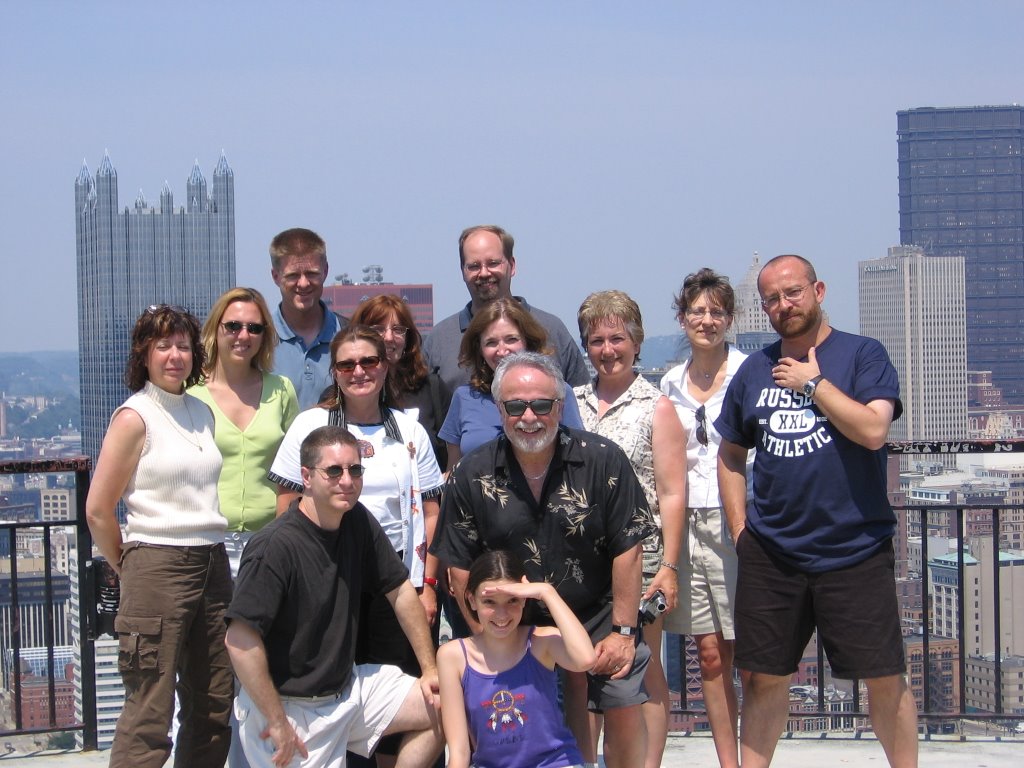
Here's a photo of us "first years" on Mt. Washington, right across from Pittsburgh's skyline. I'm not the one in the Hawaiian shirt--that's our professor who was happy to put us through our paces for a day of investigative research.
Friday, June 09, 2006
Starting the Blog
This blog is inspired by the idea that students in English Composition courses might be interested in a new forum/genre/template/context for their writing. What you'll see here is the beginnings of my foray into cyborg space so that I can practice what I preach. Here goes...
Subscribe to:
Posts (Atom)